Historical Cdrama
The Longest Day in Chang'an: A Thriller With a Clock
A death-row prisoner is let out for one day to stop an attack on the Tang capital. The series runs on the same clock as the plot.
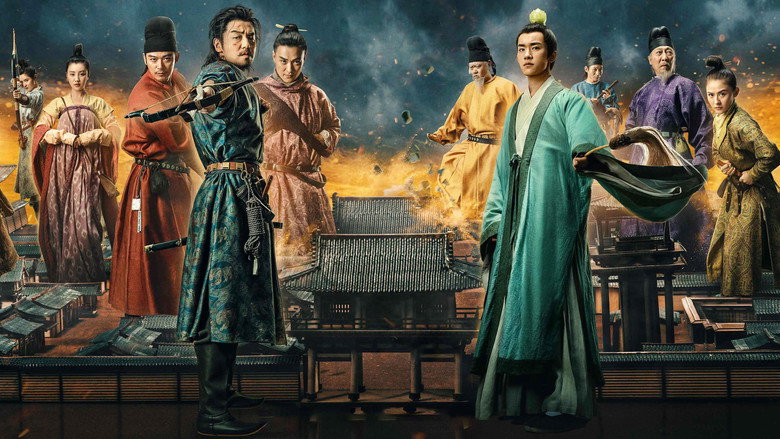
At a glance
- Chinese title
- 长安十二时辰 (Cháng'ān Shí'èr Shíchén)
- Released
- 2019, 48 episodes
- Setting
- Tang dynasty Chang'an, one festival day
- Starring
- Lei Jiayin, Jackson Yee, Zhou Yiwei
- Structure
- Real-time countdown, hour by hour
- Official streaming
- Viki (region dependent)
What it is about
On the day of a lantern festival, Tang officials learn that a group called the Wolf Squad has smuggled something into Chang'an. Zhang Xiaojing, a former soldier awaiting execution, is released for one day because he knows how the attackers think. Li Bi, a young Daoist official, is put in charge of the response. The two men have until the lanterns are lit.
The city is the other main character. Chang'an is laid out as a grid of walled wards with gates that close at night, watchtowers that pass signals, and a curfew nobody is supposed to break. Every chase is also a lesson in how the place works.
Who should watch it
Best for: thriller viewers who like procedure, maps and deadlines more than palace gossip.
- You enjoyed 24 or a heist film where the plan is explained and then broken.
- You want Tang dynasty visuals without a slow court drama.
- You are happy to read fast subtitles; the dialogue is dense with official titles.
Skip it if you want romance at the centre. There is very little, and the show keeps it quiet.
Three reasons it holds up
1. The countdown is structural, not promotional
Episodes are labelled with the hour. The plot respects the clock, so a detour costs the characters time they cannot get back. That creates tension without fake cliffhangers.
2. The production rebuilt a working city
The sets are not just pretty. Ward walls, market streets, underground passages and signal towers all function in the story. When a character takes a shortcut, you understand why it matters.
3. Two different kinds of competence collide
Zhang Xiaojing solves problems with force and local knowledge. Li Bi solves them with law, records and political leverage. Their disagreements are about method, which makes the partnership more interesting than a buddy plot.
The hidden culture detail most viewers miss
The watchtowers are not decoration. Tang Chang'an used a visual signal system to move warnings across the city faster than a rider could. In the drama, a signal seen or missed is often the turning point of an episode. Behind it sits the xiao jin (宵禁) night curfew: after the drum sounded at dusk, ordinary residents were supposed to stay inside their wards. The whole plot exploits the gap between the official city, which is closed and legible, and the unofficial city of smugglers, entertainers and night traffic that keeps moving anyway. Once you know the curfew rule, every night scene reads differently.
How to follow the clock
Each episode is labelled with an hour, and the label is not decorative. If a character says they have two hours, the next episode usually begins inside that window. Watch the time stamps the way you would watch a countdown in a heist film; they tell you when a plan is running late and when a shortcut has cost someone their life.
The geography matters too. Chang'an is a grid, and the show expects you to understand that crossing from one ward to another takes time, that gates close, and that the watchtowers can see a signal from far away. You do not need a map to enjoy it, but a rough mental picture of walls and gates makes the chases much clearer.
Subtitles are dense. Officials speak in titles and procedures, and the English track sometimes uses three words for a single office. Do not try to memorise the bureaucracy. Track the relationships instead: who reports to whom, who is protecting whose career, and who benefits if the festival goes wrong. The plot is a chain of people covering for each other, and the clock is there to stop them from doing it neatly.
One thing to notice is how the show treats the city's ordinary workers. The people who keep Chang'an running, guards, messengers, cooks and performers, are not background. Their routines are what the conspirators exploit, and their loyalty is what decides the ending. That is why the drama feels like a portrait of a city as much as a thriller about a single day.
If the first episode feels like a wall of names, that is normal. The show assumes you will absorb the politics by watching, not by taking notes. By episode three the main factions are clear, and by the midpoint the countdown takes over and the political detail becomes tension rather than homework. Give it three episodes and it will stop feeling like a history lecture.
What to watch next
If you want more Tang-era intrigue with a slower pace, try Empresses in the Palace for Qing court politics instead. For a strategist who fights with paperwork, Nirvana in Fire is the classic. Modern viewers who like the procedural side should look at The Bad Kids for a very different kind of crime story.
Where to watch officially
These buttons open the licensed platform's own search page for this drama. Availability changes by country, so the platform page is the final word on subtitles and regions.
No torrents, mirrors or Google Drive copies. If a link ever lands somewhere unofficial, tell us at yqin1090@gmail.com and we will replace it.